Any “seated” wind orchestra can turn into a marching band. For those who truly want to do it, here are a few recommendations.
Where to Start: The Instruments
First of all, it is worth giving up the “non-wind” instruments in your lineup. An organ, a piano, an electric guitar and a bass guitar all require amplification and electricity.
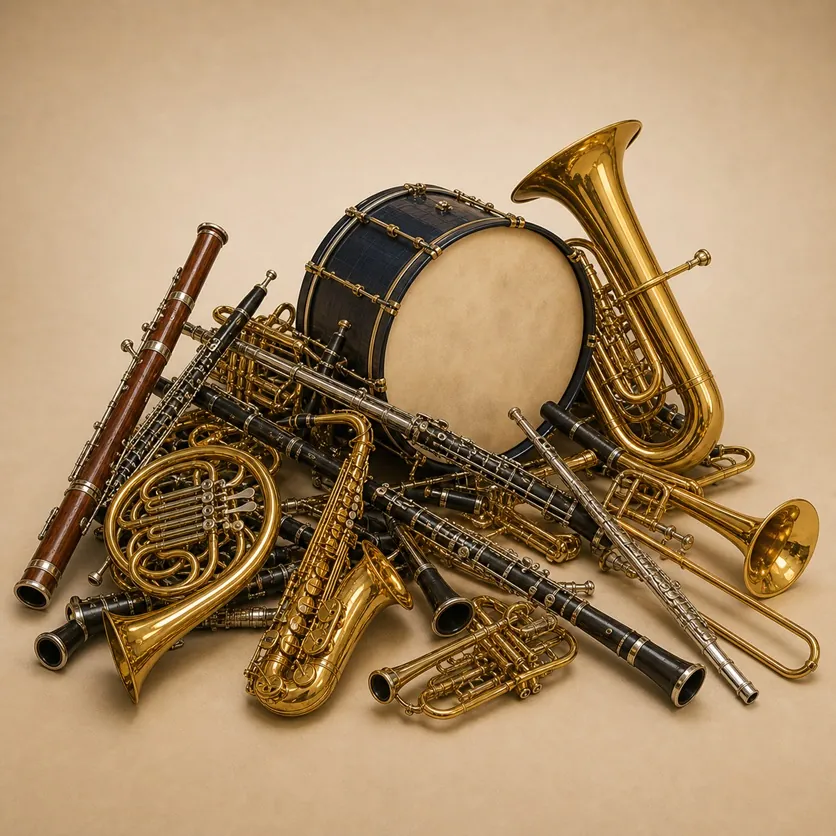
As a rule, orchestras lack low-range winds: trombones, baritones and tubas. Learning these instruments in music schools should be encouraged in every way. As a temporary solution you can use saxophones (tenor and baritone) as well as the bass clarinet. There are also the bass saxophone and the bassoon, but these are very rare instruments.
You can read more about the recommended lineup in the article “The Recommended Orchestra Lineup”.
Level One: The Mobile Band
I recommend starting by creating a mobile (portable) group. Let me explain right away the difference between a marching band and a mobile band.
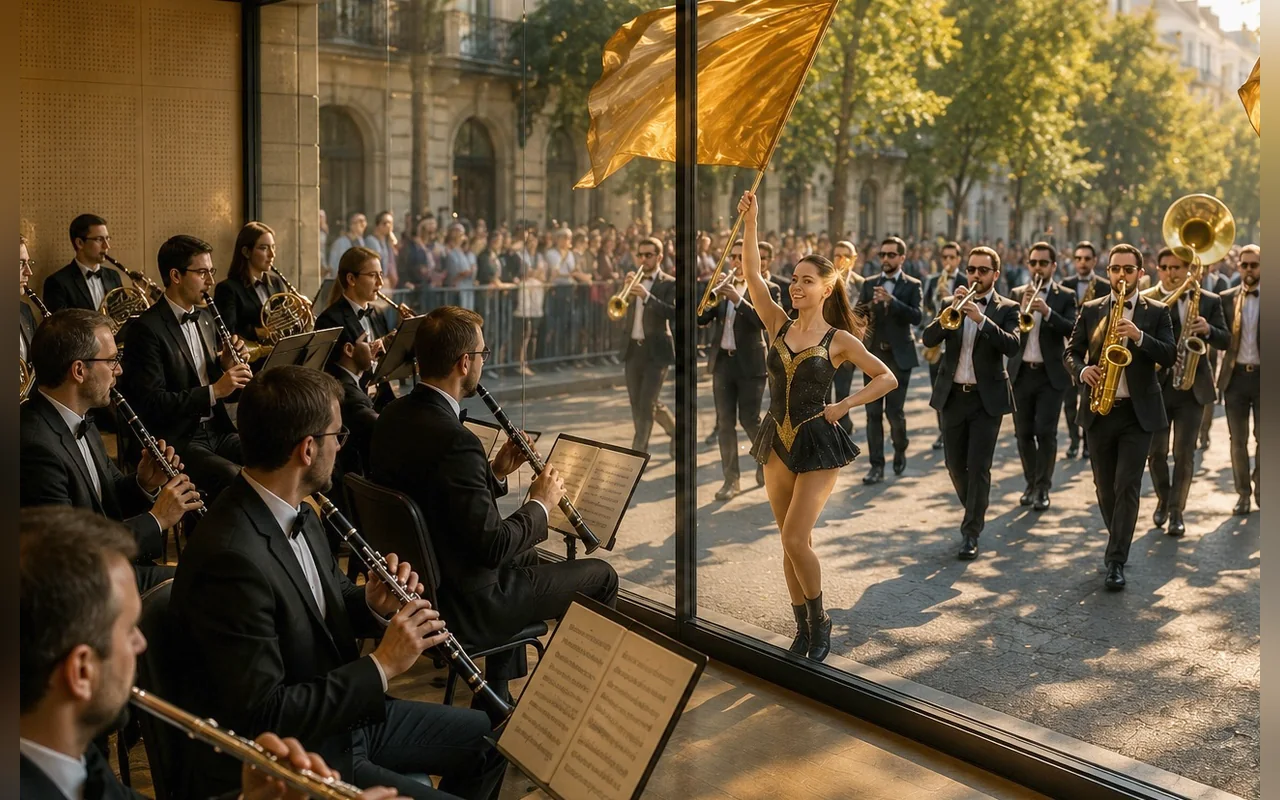
A mobile band is a wind orchestra equipped to perform outdoors. The musicians use special clip-on mini music stands (a Lyre) for a flip book of sheet music (a Flip Folder). Such a band plays, say, in a square, and can then move to another place and continue performing there. It does not play while moving — it simply moves to the “next stop.” No drill practice is required for this.
The accessories — the Lyre and the Flip Folder — are available for sale, and every musician can afford to buy them. All that remains is to fill the Flip Folder with sheet music. And that is no longer a problem either: here, on this site, I offer completely free sheet music in Octavo size, which fits the Flip Folder perfectly.
So there is not a single reason not to take this step and turn your group into a mobile band. You already have everything you need — and you can achieve it at almost no cost.
Level Two: From Mobile to Marching
It is simple: persistent drill practice will bring results — your mobile band will start playing while moving. There are plenty of videos online about the rehearsals and training of marching bands, with detailed explanations of how to learn to play on the move while staying within the group of musicians.
Level Three: Theatrical Parades
This is the “top of the craft,” requiring an enormous amount of rehearsal and skill from the participants. While playing, the musicians dance, move in groups, even run, and form huge shapes, letters and logos on a football field. Such shows involve choreographers, directors and producers of large public events.
Begin with the first step — you already know where to go from there. And to learn why a marching band is worth all this effort, read the article “The Orchestra That Finds Its Own Audience”.
Questions? Call: +972 54-622-2633.
Evgeny